This translation was prepared with AI assistance and reviewed by the editorial team.
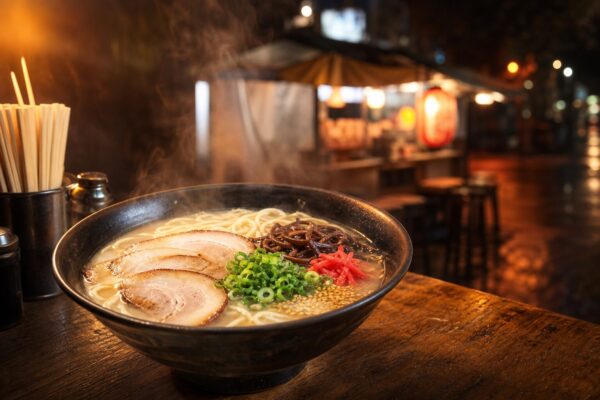
Hakata ramen is famous for thin noodles and creamy-looking pork-bone broth, but its roots are not limited to Hakata. The broader tonkotsu story begins in Kurume, develops through Nagahama’s fish-market food stalls and becomes a distinct urban style around Hakata.
Kurume is widely recognized as the birthplace of Kyushu tonkotsu ramen. Nagahama adapted it for fast-working market customers, while Hakata popularized a related thin-noodle culture nationally and internationally.
1937: Kurume’s Nankin Senryo
Kurume’s official tourism information traces the origin to Nankin Senryo, a food stall opened in 1937 by Tokio Miyamoto. Inspired by Nagasaki champon and Chinese noodle soup, he served noodles in pork-bone broth. The shop and its history remain an important reference point for Fukuoka ramen culture.
How cloudy tonkotsu broth developed
A commonly told turning point came when another Kurume shop boiled pork bones at high heat instead of gently simmering them. Fat and gelatin emulsified into the water, creating the opaque, rich-looking broth now associated with tonkotsu. It was refined by many cooks rather than invented as a single fixed recipe.
Cloudy does not always mean heavy. Aroma, fat, salinity and boiling method vary widely. Some bowls are light and sharp; others are thick and strongly scented.
Nagahama and fast noodles
After Fukuoka’s wholesale fish market moved to Nagahama in the mid-20th century, food stalls served workers who needed a quick meal. Thin noodles cooked rapidly, and extra noodles could be ordered without waiting for a full second bowl. This culture became strongly associated with Nagahama ramen.
The extra-noodle order is called kaedama. Leave enough broth, then order before finishing your first serving. The second portion is normally noodles only and has a separate charge.
Hakata, Nagahama and Kurume styles
| Style | Typical image | Remember |
|---|---|---|
| Kurume | Early tonkotsu tradition, often fuller pork character | Shops differ greatly; not every bowl is extremely thick |
| Nagahama | Very thin noodles and fast service linked to market workers | Learn noodle firmness and kaedama terms |
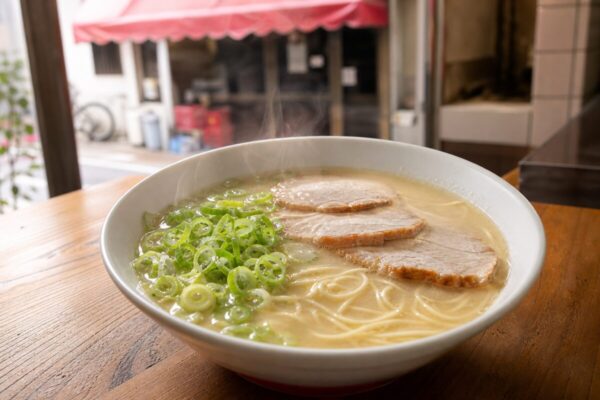
| Hakata | Thin straight noodles, pork broth and compact toppings | Now includes many classic and modern interpretations |
The borders are cultural, not legal definitions. A restaurant may use more than one label, and modern chains adjust flavor for different regions.
From local stalls to global brands
Postwar food stalls helped ramen spread through Fukuoka’s nightlife. Later, brands such as Ichiran and Ippudo introduced Hakata-style tonkotsu to customers across Japan and overseas. Their growth made customizable noodle firmness and individual preferences familiar to first-time diners.
How to order in Fukuoka
- Choose noodle firmness. “Futsuu” means regular; “kata” means firm. Very hard noodles are not automatically more authentic.
- Check whether payment is at a ticket machine before sitting.
- Add pickled ginger, sesame or spicy mustard greens a little at a time.
- Order kaedama while broth remains, and check whether you pay immediately or at the end.
- At a busy stall, keep luggage compact and avoid lingering after eating.
Continue exploring Fukuoka ramen
Compare the Hakata ramen guide, Nagahama ramen guide, Fukuoka food-stall history and ramen ordering guide. Historical reference: Kurume’s official tourism site.